

| Just a little sweet treat from our Administration to kick off our Valentine’s earlier this month. We love sharing a meal together, and reminding one another how important teamwork really is! |
Author: Mallory Kennedy

Our latest blog is up, this time highlighting the often overlooked Food & Beverage Distribution type of fleet.
As we work this year to talk through fleets that often skirt regulatory exposure we want your feedback! What type of fleet are you interested in learning more about?
Hidden Fleet Spotlight: Food & Beverage Distribution
When people think of regulated transportation, they often picture long-haul trucking operations crossing multiple states over several days. Rarely does the image include beverage distributors, foodservice suppliers, or local delivery fleets making frequent neighborhood stops. Yet Food & Beverage Distribution fleets are among the most active — and often the most misunderstood — from a regulatory standpoint.
Short routes do not always mean simple compliance.
IFTA Exposure: It’s Not About Distance
Many food and beverage distributors operate regionally, delivering products across nearby state lines as part of routine distribution. Even if trips are completed within a single day and return to the home terminal each night, crossing state lines can trigger International Fuel Tax Agreement (IFTA) requirements.
IFTA registration is generally required when a qualified motor vehicle:
- Operates in two or more member jurisdictions
- Has two axles and a gross vehicle weight or registered gross weight over 26,000 pounds
- Or has three or more axles regardless of weight
- Or is used in combination when the combined gross weight exceeds 26,000 pounds
Distribution fleets using larger straight trucks, tractor-trailers, or multi-axle vehicles often meet these thresholds — even when routes are short and predictable. Because deliveries are frequent and fuel purchases may occur in multiple states, failing to properly track mileage and fuel data can quickly create audit exposure. Many distributors do not realize they meet IFTA qualification standards until they are notified during a review or roadside interaction.
DOT Regulation: Not Just a 26,001 lb. Conversation
Another common misconception is that fleets under 26,001 pounds are automatically “non-DOT.” In reality, federal and state regulations hinge on more than CDL thresholds. Under federal guidelines, a vehicle with a gross vehicle weight rating (GVWR) or actual gross weight of 10,001 pounds or more operating in interstate commerce may meet the definition of a commercial motor vehicle (CMV). That designation can trigger requirements under 49 CFR Parts 390–399, including:
- Driver Qualification files
- Hours of Service compliance
- Vehicle inspection and maintenance standards
For distributors operating strictly intrastate, state transportation codes may adopt similar thresholds — or establish their own. Some states regulate intrastate carriers beginning at 10,001 pounds. Others align enforcement differently. The key point is this: Regulatory status is determined by how the vehicle is used and where it operates, not simply by whether it requires a CDL.
A fleet operating combination vehicles under 26,001 pounds may avoid CDL requirements but still be subject to DOT oversight depending on weight, commerce type, and jurisdiction.
Why Food & Beverage Fleets Are Often Overlooked
Food and beverage distribution fleets present unique compliance challenges:
- Frequent stops and high-density delivery routes
- Driver-sales roles that blend customer service and transportation
- Seasonal volume fluctuations
- Multi-state metropolitan delivery regions
Because transportation is often viewed as a support function — not the primary business — compliance systems can lag behind operational growth.
Practical Risk Areas to Review
Food & Beverage fleets should evaluate:
- Do any routes cross state lines?
- What are the GVWR and combined weights of delivery vehicles?
- Are mileage and fuel purchases tracked by jurisdiction?
- Are Driver Qualification and maintenance records aligned with weight thresholds?
- Have state-specific intrastate rules been reviewed?
Small oversights in these areas can result in disproportionate penalties, particularly during IFTA audits or compliance reviews.
The Hidden Exposure
The reality is that many Food & Beverage distributors are compliant in practice but undocumented in structure. The exposure isn’t necessarily unsafe operations — it’s incomplete regulatory alignment.
Understanding whether your fleet qualifies for IFTA registration or falls under state or federal DOT authority is the first step in building a right-sized compliance system that supports both efficiency and growth.
How Lee Trans Supports Distribution Fleets
At Lee Trans, we help Food & Beverage distributors:
- Determine IFTA qualification and assist with registration
- Evaluate interstate vs. intrastate exposure
- Assess DOT applicability based on vehicle configuration and operations
- Build compliance systems that align with real-world delivery models
Distribution fleets move communities every day. Ensuring regulatory clarity helps them continue doing so without interruption.
To learn more about how we support Food & Beverage fleets, visit leetrans.com.
Smith System
We’re proud to spotlight our long-standing partnership with Smith System!
For over a decade, our team have worked side by side – Smith System focusing on driver performance training, while we support fleets through DOT crash courses for Supervisors. Together, we help carriers connect driver behavior, management oversight and regulatory responsibility.
Safety works best when drivers and leadership are trained together.
Learn more about how we support fleets every day:
https://smithsystem.my.salesforce-sites.com/Registration/SG_Sites_ClassSearch_VF?classtype=d2®type=1

From our President, Jackie Polk, CTP:
Our Clean Desk Award for February goes to Julie Small. Julie does a great job managing the incoming and outgoing mail, along with the data entry of trips, logs, and fuel, all while keeping her workspace consistently organized and neat. Because her desk is visible from the lobby it reflects positively on our entire organization. In addition, Julie regularly fills in at the front desk, which requires her to stay organized, mobile, and ready to assist at a moment’s notice. Her ability to keep both work areas orderly and presentable for public view is truly appreciated and well deserving of the Clean Desk Award.

| ELD Tampering Now an Out-of-Service Violation: What Carriers Need to Know
The Commercial Vehicle Safety Alliance (CVSA) has introduced a significant enforcement change that motor carriers and drivers should understand before the next roadside inspection. Beginning with the 2026 North American Standard Out-of-Service Criteria, inspectors now have authority to place a driver out of service when an Electronic Logging Device (ELD) has been tampered with or falsified. What Counts as ELD Tampering Why CVSA Made the Change What Happens During an Inspection Why This Matters for Carriers Practical Takeaway How Lee Trans Can Help |
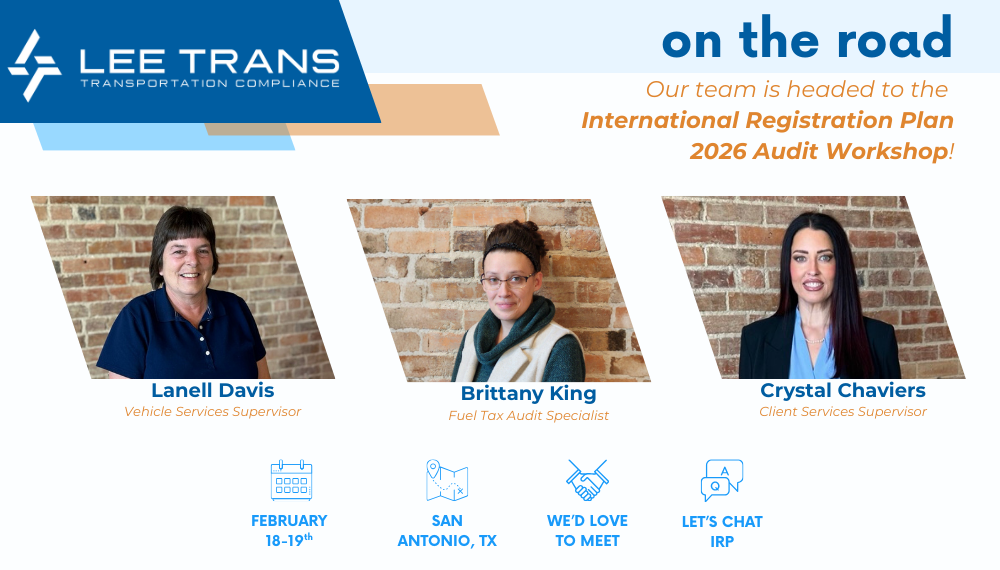
This week our team is headed to San Antonio! From our Vehicle Services Supervisor; Lanell Davis: “Our team looks forward to the IRP Audit Workshop annually to stay informed on regulatory updates, industry changes and compliance requirements. Our goal is to ensure we continue providing accurate, up-to-date support for our partners.”
Questions on IRP or IFTA? Contact sales@leetrans.com to learn more!

Wishing everyone a fun and safe day of celebration, filled with joy, music and laughter. Laissez les bons temps rouler!

Today we honor our United States’ Presidents; those individuals who have shaped the great American dream, who’ve championed change and built legacies for next generations.

Happy Valentine’s Day! From all of us at Lee Trans, we hope you have a day filled with love, generosity and kindness.

Industry Update: California Clean Truck Check
Carriers operating in or traveling through California should be aware of ongoing developments surrounding the state’s Clean Truck Heavy-Duty Inspection & Maintenance regulation. The EPA has issued a final disapproval preventing California from applying these requirements nationwide to out-of-state carriers; however, California continues enforcing the rule for in-state fleets and may still attempt enforcement actions involving interstate operators.
This creates a practical compliance challenge — carriers could still face citations or administrative issues and would need to contest them after the fact.
Lee Trans is assisting fleets with understanding applicability and completing the required registrations where appropriate. If your vehicles (14,001+ lbs., non-gasoline) operate in California, now is the time to review your exposure.
Learn more at www.leetrans.com.